
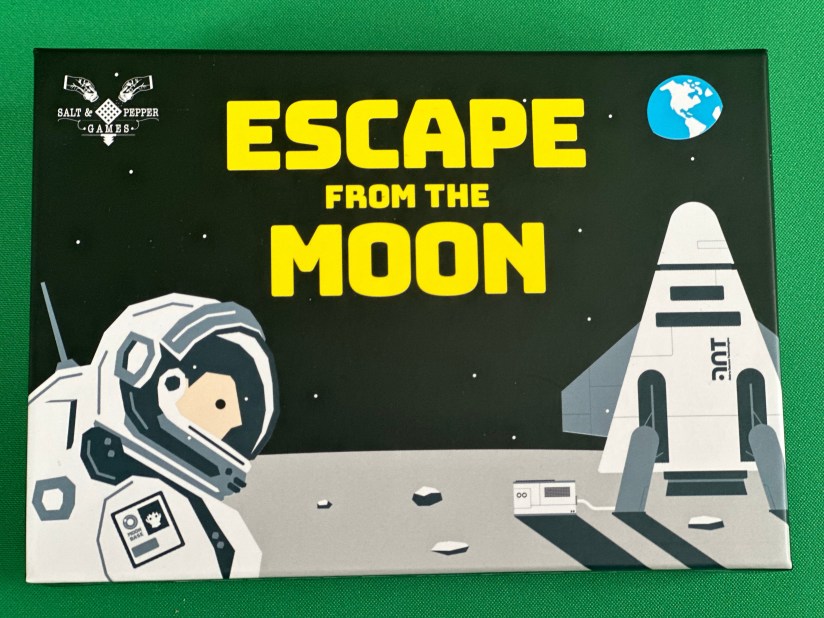
Lunch this week is Escape from the Moon by Hiroshi Kawamura. It is a solo deck-building card game with a sci-fi theme. In the game you take on the role of the only surviving astronaut and you’re trying to escape after being left on a moon base. Time is ticking and there is only so much you can do before the oxygen runs out. Not only is oxygen disappearing fast but the base you’re on is failing, limiting what you can do.
How it plays
In the game you basically have two types of action – move or search. You need to use these two actions to plot your way through the base, activate the necessary escape pod locations and then escape. You do this by playing and discarding cards from your hand. The game is made up of a number of small sets of cards, with each set doing something different. There are 8 oxygen cards which on the one hand give you the oxygen you need to keep playing, but on the other, introduce potential handicaps to your success. Then there are eleven sector cards to which you add an oxygen to create the base. This is done by shuffling the cards and creating a 4 x 3 grid (a random grid is one way to make sure each game is different.)
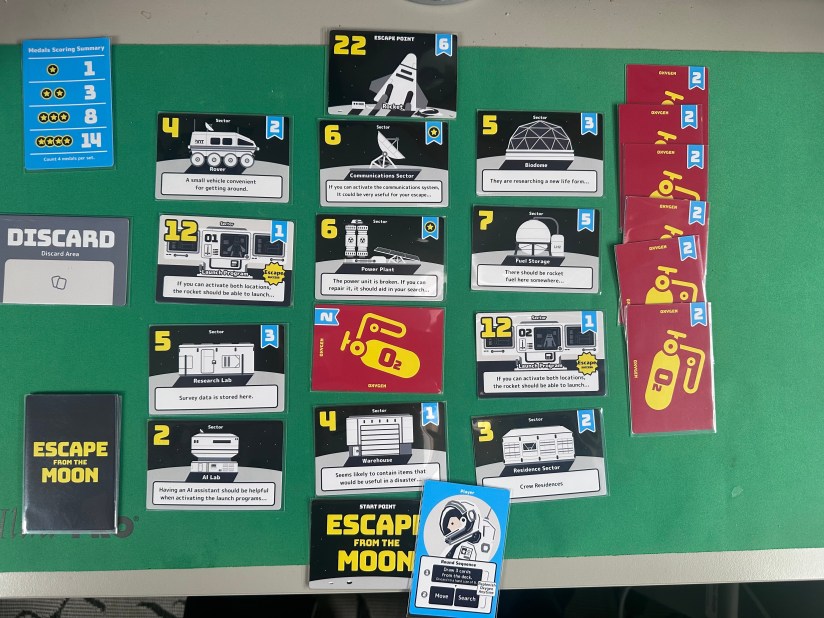
Additionally there are 8 cards that make up your starting deck, and cards that represent various things such as the start and end point. You begin with 5 cards in hand which power your move and search.
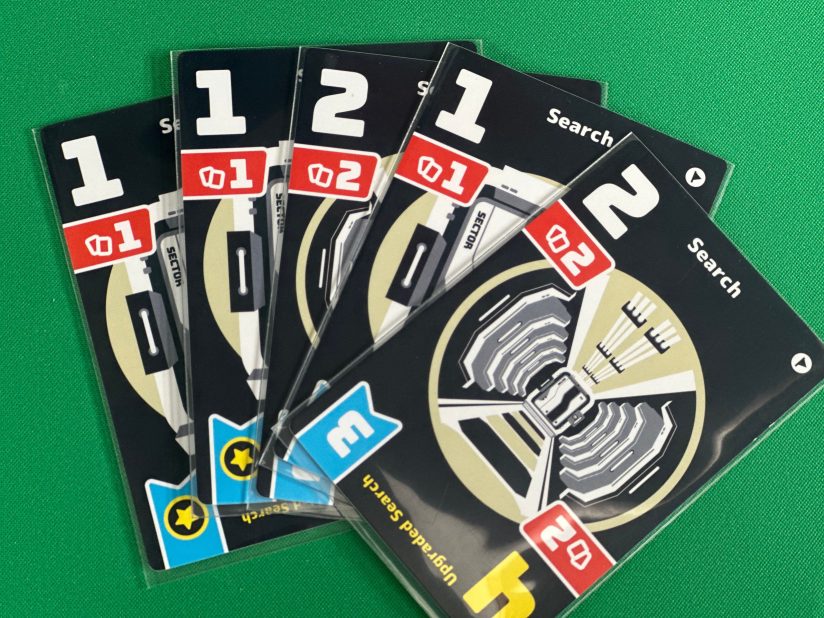
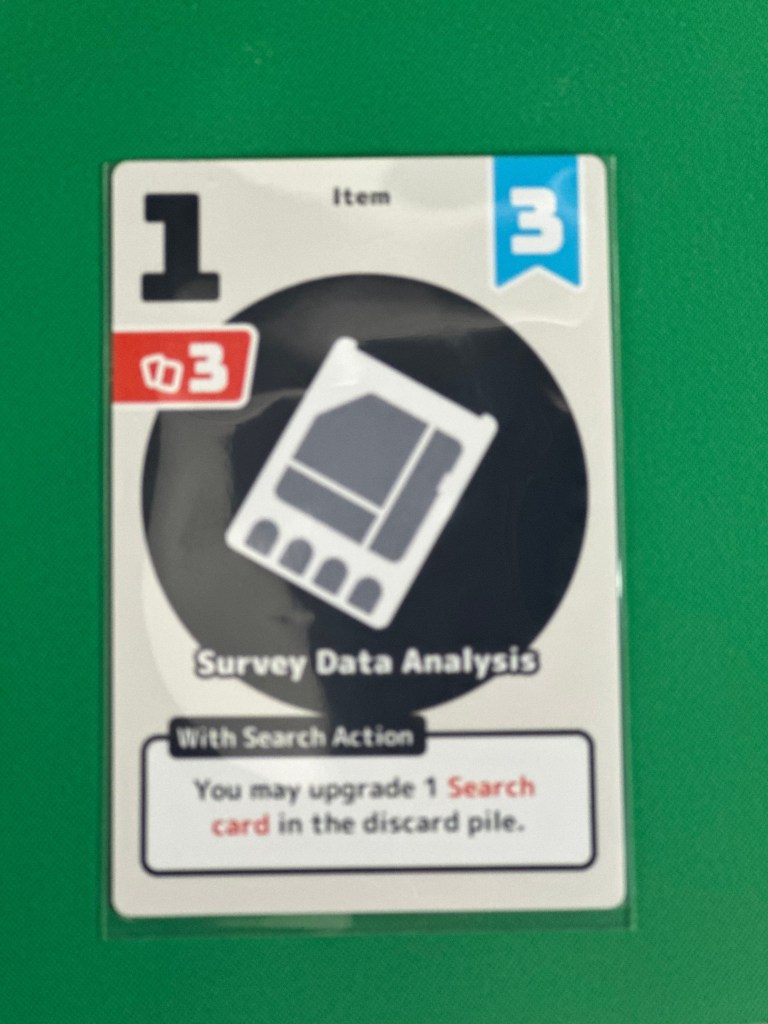
Discard a card to move the number of the card, typically one or two, and use that to move to the appropriate space in the base. Once on a space you can search it, to do this you need to be able to at least match the number on the base segment card. If it’s a 4 you need to be able to generate 4, if it’s a 12 then you need 12. You don’t have to do this is one go i.e. you can lay cards down then pick up more but doing this pretty much prevents you from moving until the search is complete. When you play a card for a search you have to ‘pay’ for it by discarding the required number of cards (the number in red on the card). When your search is successful you get to turn over the card and have the option to add it to your cards, aside from more cards to play with, each will give you an extra skill i.e. one card can, in certain circumstances, be used to add 5 to a search. Alternatively you can use the card to upgrade one of your existing cards.
At some point all this moving and searching will empty you draw pile, at this point you’ll need to refresh by adding the discarded cards (unshuffled) plus deplete one of your oxygen cards. When that card reaches your hand it will reveal an event, and block a space in your hand. To escape and, therefore, win you need to successful search the two 12 locations and then get to the exit before meeting the value of that card to escape. Do that, you win and you see how well you did by counting the points on the cards in you deck. Run out of oxygen or find yourself unable to play a card then I am afraid the moon base becomes your place of eternal rest.
Good for lunch
As with many of my lunch games, it’s a very portable game in box it’s quite small and even smaller if you just take the cards. Set up is quick, the box gives a playtime of around 20 minutes but most games I have played haven’t lasted that long regardless of success or failure. There are some inbuilt elements that aid replayability – each game you remove unseen oxygen thus you don’t know which event has been removed, you can increase difficulty by starting with fewer oxygen, and increasing the values needed to escape, and as mentioned earlier there are the varying formations of the base. The game also comes with some scenarios to be completed. It’s definitely a fun puzzle to solve, but I did find after a few plays the game came a little rote, for example I know I am going to need the AI assistant as soon as possible, so ultimately the game lacks a bit of depth. Then again do you really need depth to accompany your lunch?
 Lunch time solo