
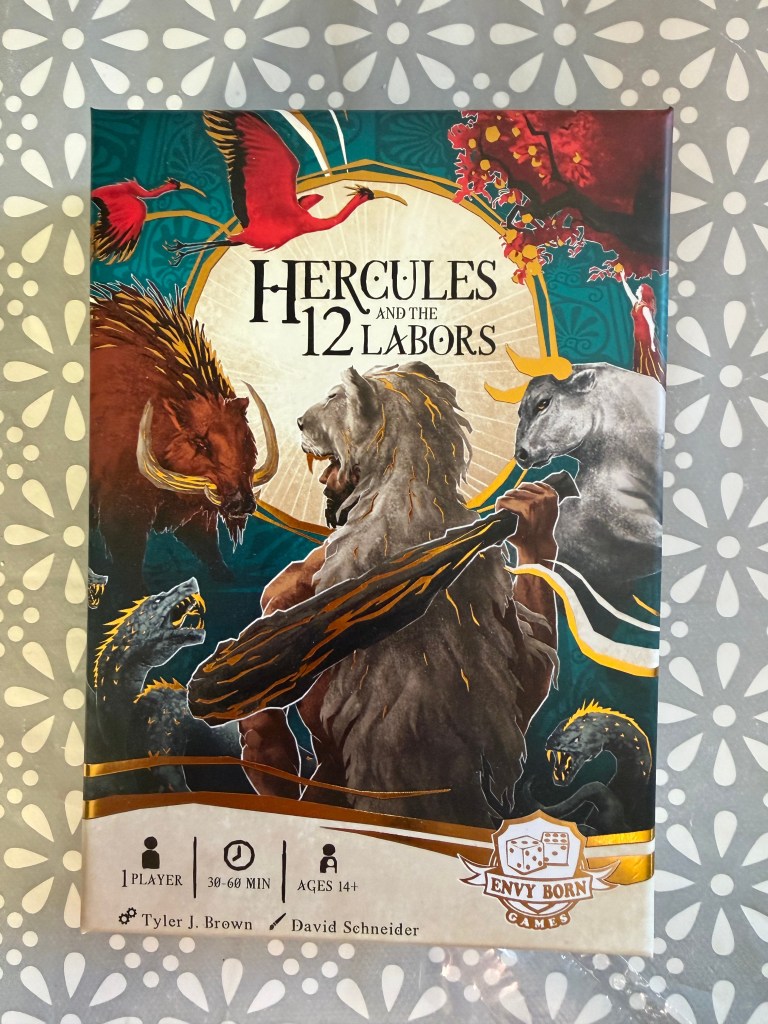
Hercules and the 12 Labors from Envy Born Games is a solo card and dice game in which you take on the role of the titular Greek demi-god trying to complete the 12 tasks as told in the Greek myth. So is conquering monsters as hard as conquering lunchtime?
How it plays
The labors themselves are a deck of beautifully designed double sided cards which one side depict the challenge and on the other give you a reward for success. The aim of the game is to work through the labors trying not to lose all your life, while gaining enough divinity to make you righteous enough to win the game. Each labour comes with a lore card which outlines the story of the labor. There is also a small deck of ‘mood’ cards one of which is drawn each labor giving you either an advantage or handicap for that labor, but more on those later. Set-up is straightforward, put out the decks and trackers, decide how many dice you want to use, then off you go.
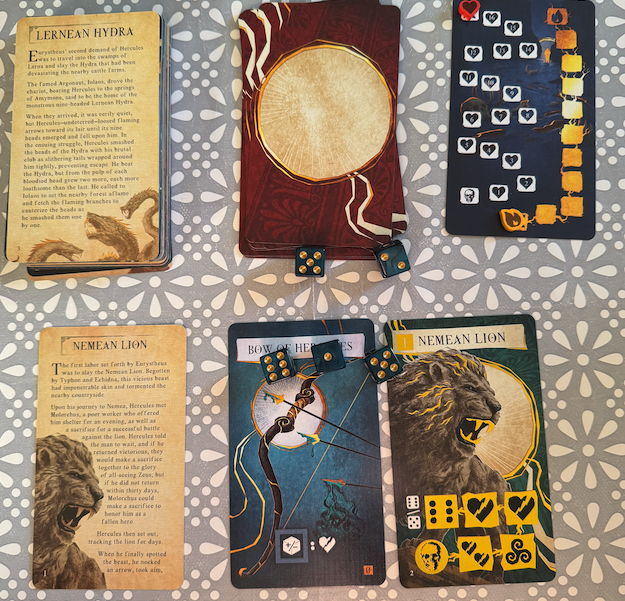
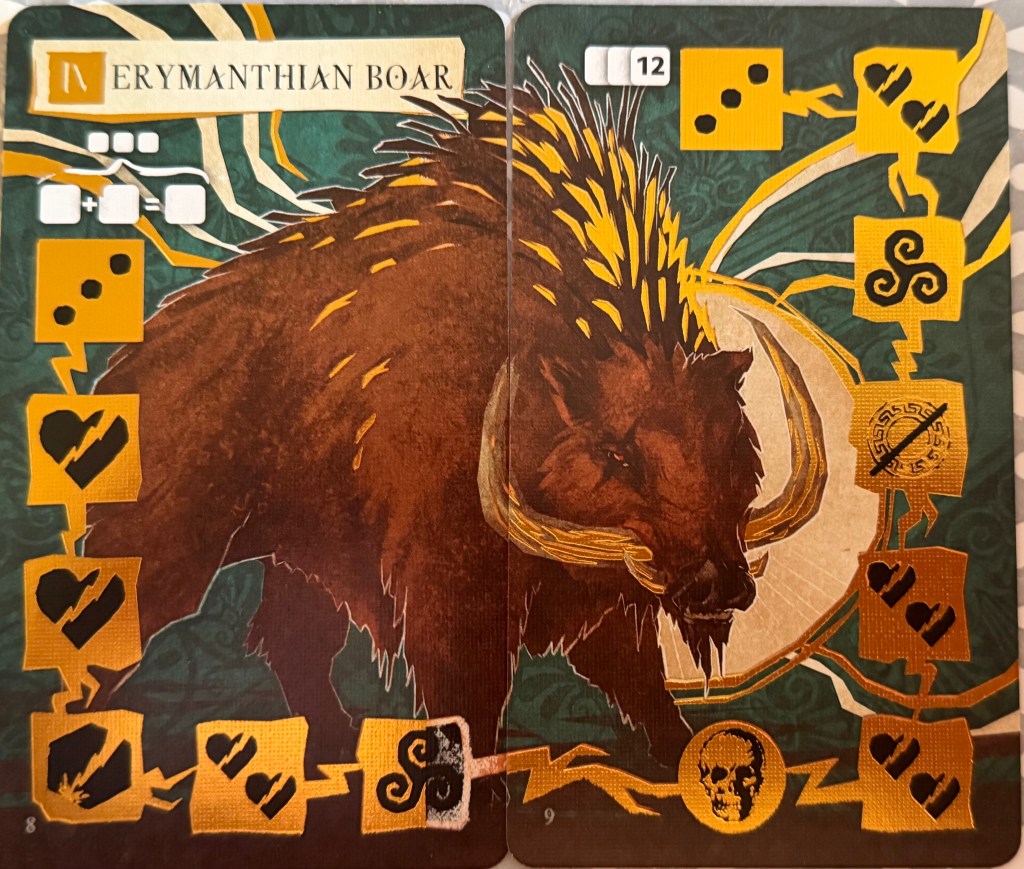
The key mechanic of the game is dice allocation. You start with a set number of dice (the exact number determines the level of difficulty) and each turn, after rolling, you place dice to active abilities or to try and conquer the current labor. In the first labour, shown above, dice rolls of 5 or 6 will reduce the life of the lion. Once it reaches zero you win. However, while life remains each turn the labour will do something to you – in this case for the first two rounds you will lose a life, and if you don’t defeat it by the ‘skull’ then it’s game over. Each labor requires a different dice configuration getting progressively more difficult with each layout, you can see in the image of the boar that to damage it you need both dice that equal a sum i.e. 1 + 2 =3 and dice that total 12. Each victory brings a reward which helps you manipulate dice. For example, the bow above allows you to alter a dice number by 1.
Good for lunch?
It’s a relatively small box with a simple set up taking matter of minutes so from that aspect, it’s a big tick. Additionally the artwork is gorgeous, and it’s a difficult game both of which really draws you into the theme of the game. Despite the rinse and repeat (choose labor, roll dice, beat labor) the variety in the dice requirements does stop it from becoming to laborious (pun intended) in gameplay. Unlike many of the games reviewed on this site, this is not a 10-minute game(unless you lose to the lion!) So far, I have managed to get through 5 labors in one game which took a good 40 minutes. You spend a lot of time contemplating how best to use your dice once you have a few rewards. That said it is easy to stop the game , pack it away and continue it another time. So another lunchtime tick. Solving the puzzle is, well should be, fun and in itself it is. I do find it satisfying to work how best to use my dice but…
Let’s talk about moods
There is always going to be a randomness about a game that requires you to roll and allocate dice, you can’t legislate for what you’re going to throw. The lion needs you to roll 5 and 6s, you could roll 5 dice and get none – the bow mitigates one assuming – it’s a four you can use the +1 to make it a five but if this sequence happened five times in a row you’d lose the game simply because you can’t roll the right number. So for those gamers that like to plan, this randomness can be frustrating though in itself I didn’t really mind it.
What caused me utter frustration were the mood cards. I really don’t see the point of them. In a game where the main cards have been clearly crafted for theme, the mood cards are unexplained – there is no clear explanation of their thematic inclusion in the rulebook. Presumably it is meant to replicate:
“a man tangled in guilt, a half-god tormented by past sins. Carrying the weight of a tumultuous life and an impossible lineage, he yearns to atone and lay down his sorrows.”
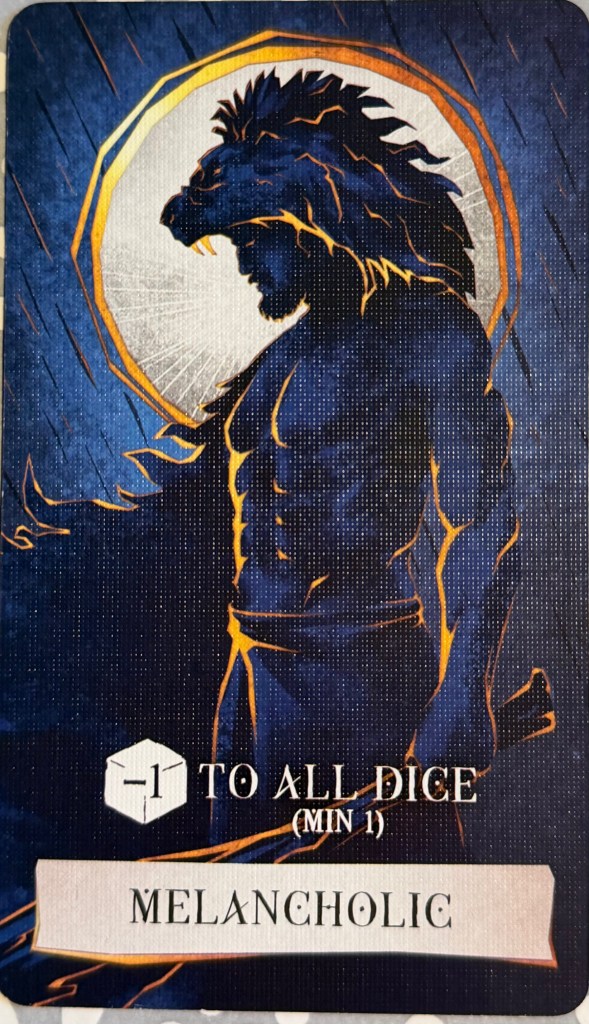
as stated the intro to the game but this is not explicitly said. These cards can add a positive effect but they can also be negative – ‘melancholic’ reduces your dice by one which is truly frustrating when you need 6s. Others simply remove some of your life, having worked hard to stay alive during the 4th labour, my game ended at the start of the 5th when I drew the mood that removed three hearts! Dice are random so why double down with random card drawing?
So good for lunch? In the end, Hercules and the 12 Labors stands out as an experience that captures the spirit of its mythological inspiration. Its engaging challenges, satisfying progression, and thematic flair make it easy to appreciate, especially for players who enjoy adapting on the fly. That said, the heavy reliance on randomness can undercut the sense of control, turning some moments of triumph into moments of utter frustration. While this unpredictability might add replay value and surprise, it can certainly test the patience of players looking for consistent strategy.
 Lunch time solo