
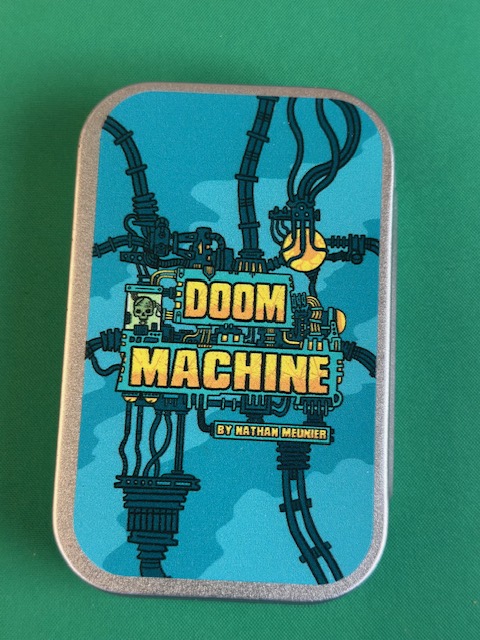
This week’s lunch is Doom Machine by Nathan Meunier. It’s a solo dice game which was on Kickstarter a few years ago, but can still be bought as a print and play. This version of the game fits neatly into a mint tin, making it highly portable. The premise of the game is that you need to defeat an ever-evolving machine that wishes to wreck death and destruction on humanity. It’s incredibly tough to win, I’ve never beaten it but then again maybe that’s just me playing badly!
How it plays
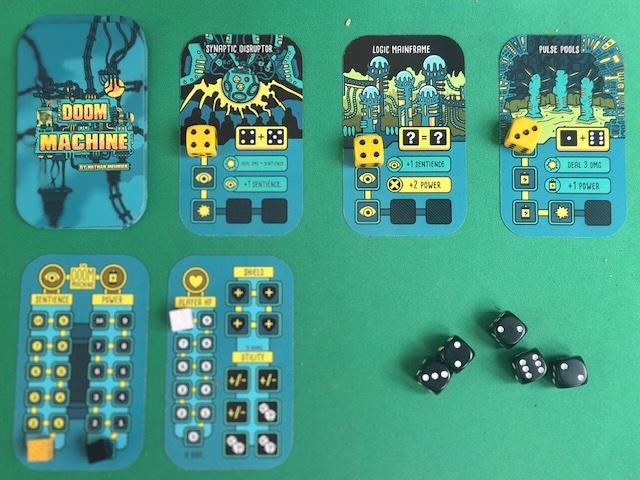
There is minimum set up to the game – take it out the tin, and place the two cards that track your health, and the machine’s sentience. Find the machine’s core then shuffle the rest of the cards (these represent the different parts of the machine. Remove 6 cards and put them back in the tin, then add the core to bottom of the stack of the remaining cards. Turn over three adding dice to represent their HPs, and you’re ready to go. A turn consists of you rolling your dice and try to utilise them to both damage the machine and protect yourself from it. You begin with only 5 dice so choices at the start are limited and as a result a little angst-ridden. Aside from assigning dice as damage by matching a die to the required symbols on a card, you can also use them to act as shields or activate things such a reroll or adjust the die number. Your dice pool grows if and when you beat parts of the machine. Once you have taken your turn the machine makes its move usually doing you damage or making itself stronger. To represent its actions the dice on each card moves along a track. This lets you try and plan for what the machine will do each turn, thus hopefully allowing you mitigate damage etc. The good news if you survive the machines turn, you start a new round, the bad news is that each round a new part of the machine is added thereby giving you another thing you have to deal with. And so the game continues, if you survive until the last card is turned over then you reveal the machines core, defeat that and you win.
Good for lunch?
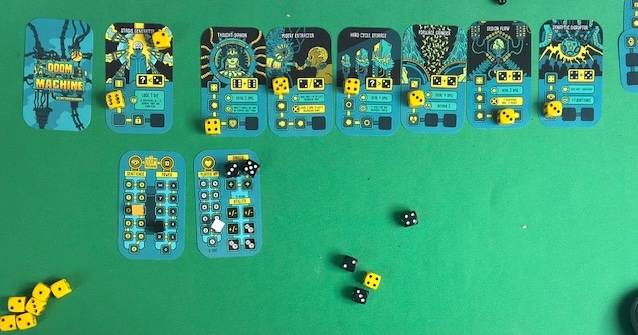
Being a game in mint tin it’s perfect for playing at desk be it like me at home or if you have to go into the office (it’s a small and not heavy tin so easy to transport.). Even when all the cards of the machine are in play it doesn’t take up much room. There are a few icons that you need to get to grips with but game play is easy, roll and use dice, move the machine’s dice then rinse and repeat. It’s an easy but fulfilling gameplay especially when the dice roll in your favour. Since the game has a random set up with random cards removed it means each game provides new challenges as the machine is built in different ways. That said, this random order can be very frustrating when the tough cards all come out first! Any game based on dice throwing can have an element of frustration, even with the game’s inbuilt way of mitigating throws there’s little you can do if you throw a bunch of ones and twos and none of the cards bear that number. Games last around 20 minutes with a growing sense of tension as the machine gets closer to its core and you foolishly think that this time round you’re going to finally defeat it. As they say ‘it’s the hope that kills you’ so if you like your dice, false hope and a chance to save the humanity from annihilation then Doom Machine is pretty good lunchtime fare.


 Lunch time solo